
Bookmarks

Sunday, 25 December 2016

Thursday, 1 December 2016

Wednesday, 30 November 2016
Like Christmas in My Mailbox Today
When I went to check my mailbox today there was a suspicious package addressed to me. I wasn't too worried because it came from St. Martin's Press. I honestly didn't remember ordering anything and I wasn't expecting an ARC so I anxiously opened the box.
What a great surprise! When I saw the contents I remembered entering a giveaway but didn't know I was a winner..
The box contained a pound of "Eve Dallas Roast - Dublin Roasters" coffee. Mmmmmm! Now I get to taste what all the fuss is about in J.D. Robb's "In Death" books when Eve looks forward to drinking her "real" coffee that Rourke procures for her. When I opened the package the aroma was amazing. And BONUS ... it's free trade and organic! Of course I had to brew some right away. It tastes as good as it smells and I had some cookies stashed away from baking I did on the weekend. Perfect!

I am going to be quite greedy and squirrel this away for me. Okay ... I'll share with my BFF who is also a huge J.D. Robb fan.

Thank you very much to St. Martin's Press and Dublin Roasters for the delicious surprise.

30/30
What a great surprise! When I saw the contents I remembered entering a giveaway but didn't know I was a winner..
The box contained a pound of "Eve Dallas Roast - Dublin Roasters" coffee. Mmmmmm! Now I get to taste what all the fuss is about in J.D. Robb's "In Death" books when Eve looks forward to drinking her "real" coffee that Rourke procures for her. When I opened the package the aroma was amazing. And BONUS ... it's free trade and organic! Of course I had to brew some right away. It tastes as good as it smells and I had some cookies stashed away from baking I did on the weekend. Perfect!

I am going to be quite greedy and squirrel this away for me. Okay ... I'll share with my BFF who is also a huge J.D. Robb fan.

Thank you very much to St. Martin's Press and Dublin Roasters for the delicious surprise.
30/30
Tuesday, 29 November 2016
The Vanishing Valazquez - A Review
THE VANISHING VALAZQUEZ by Laura Cumming

John Snare purchases a portrait of Prince Charles with the suspicion that the artist is Diego Valazquez. As the subtitle of this book suggests that painting became his lifelong obsession and ultimately his ruin.
This book has three main themes; John Snare’s obsession with the painting and the impact it has on his life, art history featuring the times and works of Valazquez and the history between England and Spain. All of them interesting in their own right and the research Ms. Cumming did is obviously extensive. She goes into great detail for all three of the themes. I found each interesting and enjoyed Ms. Cumming’s writing.
The flow of this book is where I had some issues. It jumped around a little too much. I understand wanting to intersperse the history of the painting with Snare’s story but often the information didn’t quite mesh coherently.
That aside it was an interesting read and anyone interested in Diego Valazquez and his works will enjoy this book. I would highly recommend purchasing a physical copy of the book because it does include photographic reproductions of the paintings that an eReader does not do justice. (I ending up reading the book and googling the paintings)
I received this book at no charge from the publisher, Scribner
via Netgalley in the hopes of an honest review.
ABOUT THE AUTHOR (her Simon and Schuster author page)

Laura Cumming has been the art critic of the Observer since 1999. Previously, she was arts editor of the New Statesman magazine, literary editor of the Listener, and deputy editor of Literary Review. She is a former columnist for the Herald and has contributed to the London Evening Standard, the Guardian, L’Express and Vogue. Her book A Face to the World: On Self-Portraits was widely reviewed to critical acclaim.

29/30
Monday, 28 November 2016
The Obsidian CHamber - A Review
THE OBSIDIAN CHAMBER by Douglas Preston & Lincoln Child
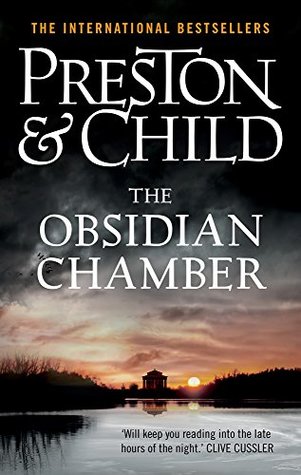
This installment in the Pendergast series starts off at almost the exact point the last book (Crimson Shore) ended. Pendergast is still missing and presumed dead, Constance goes into self-imposed exile in the chambers beneath the mansion and Proctor is standing guard. Standing guard until it seems as if Constance is kidnapped. A wild, cat and mouse chase starts the action moving in a non-stop, breath-stopping manner. When we discover that the chase is in fact a wild goose chase we return to the manor to find strange things afoot.
It’s no secret that A.X.L.’s brother Diogenes has returned from the (presumed) dead, this has been clearly hinted at in the last two books; the Obsidian Chamber confirms his return. To all outward appearance he comes back as a changed man. Is it too good to be true?
Reports of Agent Pendergast’s demise are also found to be premature as he fights for his life after being fished aboard a boat manned by drug runners who know the bargaining power of having in F.B.I. agent in their grasp.
Individually those three plot lines make up approximately half this book. Each plot line is suspenseful and interesting, so much so, that it kept me avidly reading to find out what happens. Unfortunately when the plot lines converge the story seems to lose some its momentum. I usually enjoy the novels that feature Constance at the center of the action and in the last two books it seemed that Constance had finally come in to her own. Obsidian Chamber seems to set her back a few steps and she becomes a strange hybrid of shrinking violet and ninja warrior. I still believe that Pendergast is one of the more original “agents” in thriller books and I enjoy his quirkiness and resourcefulness – almost a cross between prim and proper Mary Poppins with her magic bag and McGyver with all the tricks up his sleeve. In this book I almost feel the book would have progressed better if he had just shown up and the end … everyone relieved that he was alive.
Constance’s decision at the end of the book almost seems a step backwards and I fear the books will become a bit of a “rehash” with names changed to disguise repetitiveness. I hope not because I enjoy the series but the word “stale” popped into my mind on more than one occasion while reading this one.
Overall it’s not a bad read but holds nothing in comparison to the early books in the series.
I received this book at no charge from the publisher, Grand Central Publishing via Netgalley in the hopes of an honest review.
ABOUT THE AUTHORS (from www.prestonchild.com)

Douglas Preston was born in Cambridge, Massachusetts, in 1956, and grew up in the deadly boring suburb of Wellesley. Following a distinguished matriculation at a private nursery school-he was almost immediately expelled-he attended public schools and the Cambridge School of Weston. Notable events in his early life included the loss of a fingertip at the age of three to a bicycle; the loss of his two front teeth to his brother Richard's fist; and various broken bones, also incurred in dust-ups with Richard. (Richard went on to write The Hot Zone and The Cobra Event, which tells you all you need to know about what it was like to grow up with him as a brother.)
He is a Fellow of the Royal Geographical Society. In 2011, Pomona College conferred on Preston the degree of Doctor of Letters, honoris causa. He is an avid skier, mountain climber, and hiker.
He counts in his ancestry the poet Emily Dickinson, the early sexologist Robert Latou Dickinson, and the infamous murderer and opium addict Amasa Greenough. He divides his time between New Mexico and Maine.
Lincoln Child was born in Westport, Connecticut, which he still calls his hometown (despite the fact that he left the place before he reached his first birthday and now only goes back for weekends).
Lincoln seemed to have acquired an interest in writing as early as second grade, when he wrote a short story entitled Bumble the Elephant (now believed by scholars to be lost). Along with two dozen short stories composed during his youth, he wrote a science-fiction novel in tenth grade called Second Son of Daedalus and a shamelessly Tolkienesque fantasy in twelfth grade titled The Darkness to the North (left unfinished at 400 manuscript pages). Both are exquisitely embarrassing to read today and are kept under lock and key by the author.
A dilettante by natural inclination, Lincoln's interests include: pre-1950s literature and poetry; post-1950s popular fiction; playing the piano, various MIDI instruments, and the 5-string banjo; English and American history; motorcycles; architecture; classical music, early jazz, blues, and R&B; exotic parrots; esoteric programming languages; mountain hiking; bow ties; Italian suits; fedoras; archaeology; and computer MMORPGs.

28/30
Sunday, 27 November 2016


Saturday, 26 November 2016
The Other Einstein - A Review
THE OTHER EINSTEIN by Marie Benedict

Mitza Maric was an anomaly in her hometown. She was a young woman with a handicap that made her “not marriage material” in everyone’s eyes and she was intelligent, which in her time period also seemed to be a strike against her. She was, however, fortunate enough to have a father who not only adored her but nurtured and applauded her intelligence. So, when other young girls her age were marrying and starting families Mitza was moving to Zurich to attend the University to study physics.
While it took her a long time to fit in with most of her fellow (all male) students she did find kindred spirits in the other girls residing at her boarding house, other females also pursuing an education. Her professor continued to single her out and often ridicule her but the other students begin to understand her intelligence and reluctantly accept her … particularly one young man name Albert Einstein.
Friendship soon turned to more and after many obstacles to their relationship they married. With two such brilliant minds the physics theories couldn’t help but flow freely. But were the ideas all Albert’s or did Mitza have a significant contribution to his brilliance? That is the question Ms. Benedict poses in this work of historical fiction.
As is expected much is known about Albert Einsten, but Mitza seems to have been ignored by history books in favor of her husband and his second wife. Ms. Benedict writes a very believable and entertaining story based on the supposition that Mitza not only contributed to Albert’s genius but also may have come up with some of the theories always accredited to him. She also gives plausible explanations as to how this may have come about. All these things combined made for a very interesting read.
Historical fiction is by its very description supposition involving dialogue that no one could have recorded and private moments that can only be guessed at. Ms. Benedict seamlessly blends these fiction aspects into the time period and what is known about Einstein. While reading “The Other Einstein” I never once shook my head with the thought “no way!” In fact, often the opposite was true and I found myself getting angry at the circumstance Mitza endured. Much in the same way one cannot imagine one’s parents as young lovers, where I had to suspend disbelief, the most was with the descriptions of the wild haired genius as a young man passionately pursuing the woman he loved. Of course, given his history with women Ms. Benedict did an admirable job of that side of Einstein as well.
Science was a major part of their early relationship and commonality, but Ms Benedict approached that aspect in a very readable manner. Sometimes the theories were out of my grasp but that in no way bogged down the story instead only served to emphasize just how brilliant Mitza was.
Good historical fiction read. I would certainly not hesitate to seek out another of her books.
“I received this book at no charge from the publisher, Sourcebooks Landmark, via Netgalley in the hope of receiving an honest review.”
ABOUT THE AUTHOR (from www.authormariebenedict.com)

Marie Benedict is a lawyer with more than ten years' experience as a litigator at two of the country's premier law firms. She is a magna cum laude graduate of Boston College with a focus in History and Art History, and a cum laude graduate of the Boston University School of Law.
While practicing as a lawyer, Marie dreamed of a fantastical job unearthing the hidden historical stories of women -- and finally found it when she tried her hand at writing. She embarked on a new, narratively connected series of historical novels with THE OTHER EINSTEIN, which tells the tale of Albert Einstein's first wife, a physicist herself, and the role she might have played in his theories. Writing as Heather Terrell, Marie also published the historical novels The Chrysalis, The Map Thief, and Brigid of Kildare.

26/30
Subscribe to:
Posts (Atom)