Bookmarks

Bookmarks
Showing posts with label Story Quilts. Show all posts

Wednesday, 25 May 2016

Fashion. Titanic. Scandal ... My Local Connection

I recently read and reviewed the book "The Dressmaker" by Kate Alcott.  A principal character in the book was Lady Lucile Duff Gordon.  I knew that the character in the book was based on a real person, an early 20th century fashion designer and fashion innovator.

Tidbit:
 She was a trendsetter; introducing the first runway fashion show with live models, designing a line of "ready-to-wear" designer clothes for women and designing fashion/costumes for Broadway plays.

Unfortunately, despite her enormous contribution to the early days of the fashion industry what Lucile is most known for is being on the Titanic's first and only voyage and her allegedly deplorable, (dare I say it?) inhumane behavior as the ship went down.


What I did not know, and learned through happenstance watching a local news broadcast, was that Lady Duff Gordon had a local connection to my little part of the world.  I was puttering around in the kitchen getting supper things cleared from the table when her name being announced caught my attention.  So I immediately began listening a little more closely.  I learned that Lady Duff Gordon had lived part of her, somewhat notorious, life in Guelph, Ontario, Canada.  And ... the Guelph Civic Museum happened to be having an exhibit featuring her that was going on right now.  Well ... I knew I had to visit the exhibit.  After all, there is no such thing as coincidence, right?  So this past Victoria Day weekend I spent a couple of hours on Saturday afternoon exploring the Guelph Civic Museum - a lovely building that I not visited before - and learning just a little bit more about this woman with the local connection.
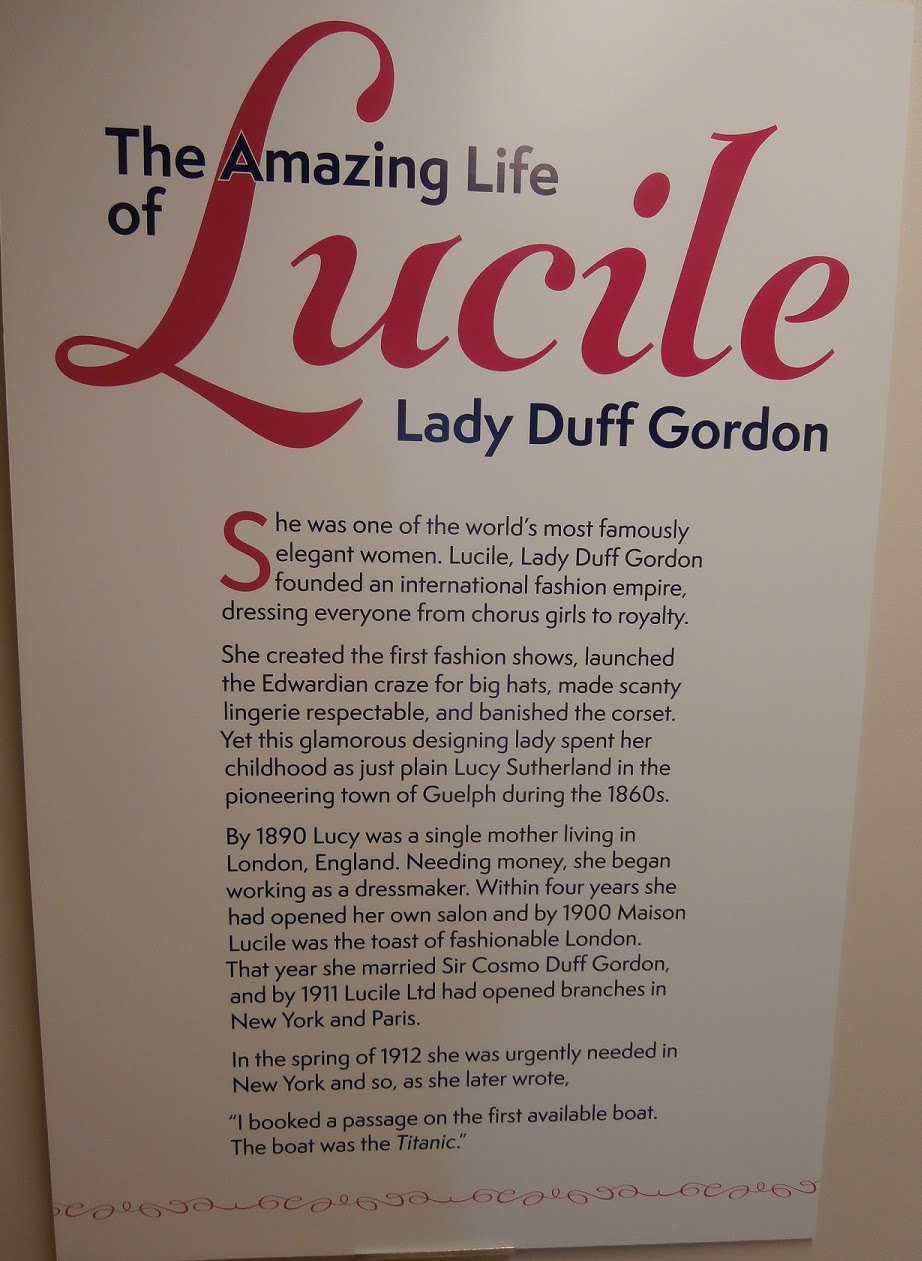

The exhibit was staged on two floors of the museum, the first floor dedicated to her early years in Guelph and the "Titanic Incident" and the third floor dedicated to actual samples of her dresses and fashion innovations.

Tidbit:
She is partly responsible to getting women out of corsets and fashioning more
comfortable lingerie.  Sounds like the Victoria Secret of her time.  There is still a line of lingerie marketed under the "Lucile, Established 1890" label today.

THE LADY

Lucy Christiana Sutherland was born on July 13, 1863 to Douglas Sutherland, a Toronto civil engineer and his wife Elinor Saunders, an Anglo-French-Canadian.


As I was wandering the exhibit I overheard two other patrons, rather elderly ladies, discussing the picture of the house were Lucile was raised ... commenting that the house is still standing albeit sans wrap around porch.  All right ... YES! ... I WAS eavesdropping.


Lucile began sewing early in her life.  There probably wasn't much else to do in Guelph in the late 1800's?   At the age of seven she began making dresses for her dolls with materials from cases of cast off clothes and fabrics which were sent yearly from relatives in France.  She soon moved on to making dresses for herself and her sister, future novelist Elinor Glyn.


Lucile married for the first time in 1884, when she wed James Stuart Wallace.  Alas, despite having a child together, daughter Esme, the marriage was not a happy one.  Wallace was a alcoholic and was involved in several not so discreet love affairs.  Lucile consoled herself in love affairs of her own and in 1890 they separated and Lucile began divorce proceedings.  In 1900 she married Cosmo Duff Gordon, a wealthy Scottish landowner and sportsman.


THE FASHIONS

After her divorce from Wallace Lucile had supported herself and her daughter by working as a dressmaker.  Before long she had opened Maison Lucile, in the fashionable west end of London.  From all accounts Sir Cosmo supported Lucile's venture's into the fashion industry and invested in her business.  In 1910 she opened her first "fashion house" in New York City.  It was an almost instant success and it wasn't long before she moved to a larger venue.


Lucile made a name for herself on Broadway as well, designing many fashionable costumes for the stage and for the new phenom - the silver screen.  One of her frequent and loyal customers was Ontario born movie legend Mary Pickford.


Tidbit:
Lucille Limited can rightly be called the first international leading house of couture as in addition to her New York house, she opened a house in Paris in 1911 and in Chicago in 1915.  She was legitimately international with couture houses in three countries. 

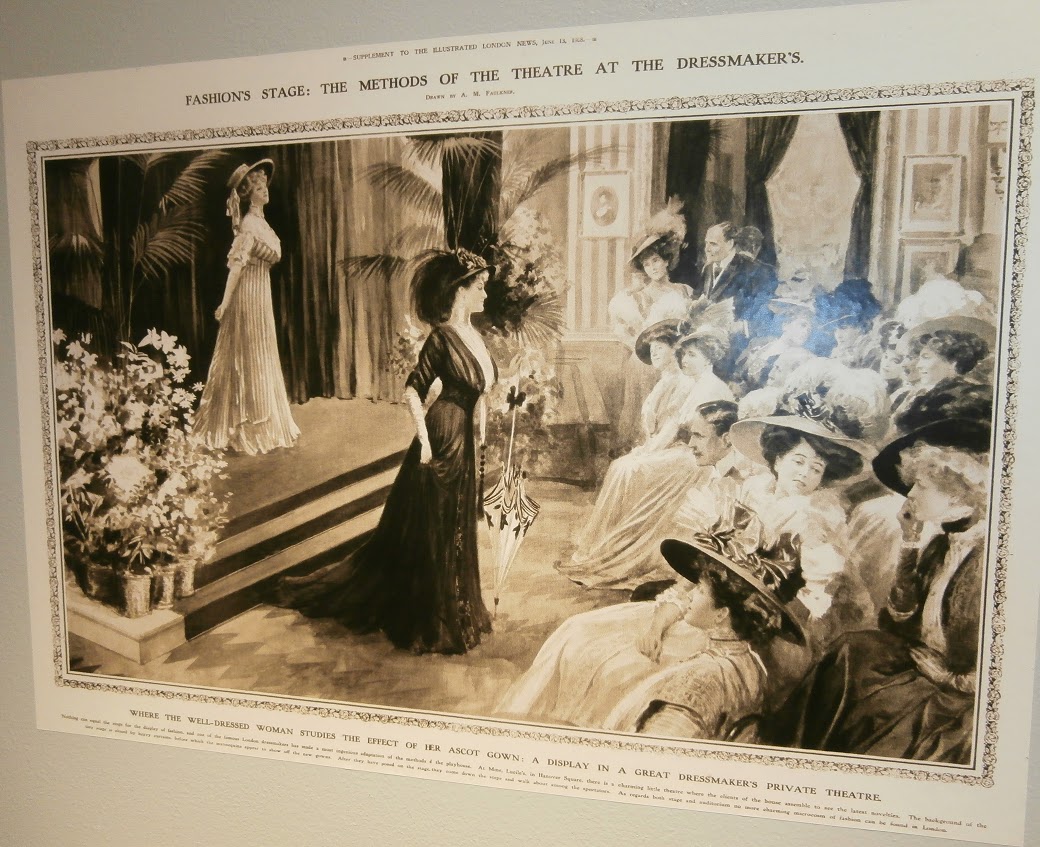
Despite her success, the "French fashion world was scornful" and she often found herself the subject of cartoonists because of her innovative and the, hitherto unheard of,  idea of using "live mannequins" to model her clothes.


Lady Duff Gordon would enlist pretty shop girls working for her, dress them in her designer clothes and parade them around the room as "live mannequins" while patrons enjoyed tea and treats.  Although the practice was scoffed at and ridiculed at the time, we all know how that turned out ... can we say Milan, Paris, New York and Toronto Fashion Weeks!


 THE TITANIC

With her success as a fashion designer and her husband being a Baronet, money seemed to be no object for the Duff Gordons.  Needing to travel to America they booked first class passage on maiden voyage of the ill-fated Titanic.  For some unknown reason they booked their passage under the names Mr. and Mrs. Morgan.  Of course we all know that the Titanic hit an iceberg and began to sink.  As passengers were being evacuated Lucile, Cosmo and Lucile's secretary Laura Francatelli were placed in Lifeboat 1, the fourth lifeboat to be launched approximately one hour after the ship struck the iceberg.  The lifeboat was a "cutter" designed for the emergency use of the Titanic crew so had less seats than the other lifeboats.  Despite it's smaller size (pictured below) it still had a maximum capacity of 40 people and was launched with only 12 persons aboard.  Despite the infamous call for "women and children first" Lifeboat 1 carried 10 male passengers (seven of whom were crew members).

Lifeboat 1 was dubbed "the money boat" because of it's not near capacity cargo and rumors that Lord Duff Gordon had bribed the seamen on board to
keep rowing and not allow any of the multitude of people in the water to climb into the lifeboat.  Taking a page from Marie Antoinette's "let them eat cake" guide, Lady Duff Gordon even commented to her secretary that it was too bad that she had now lost her "beautiful nightdress". 

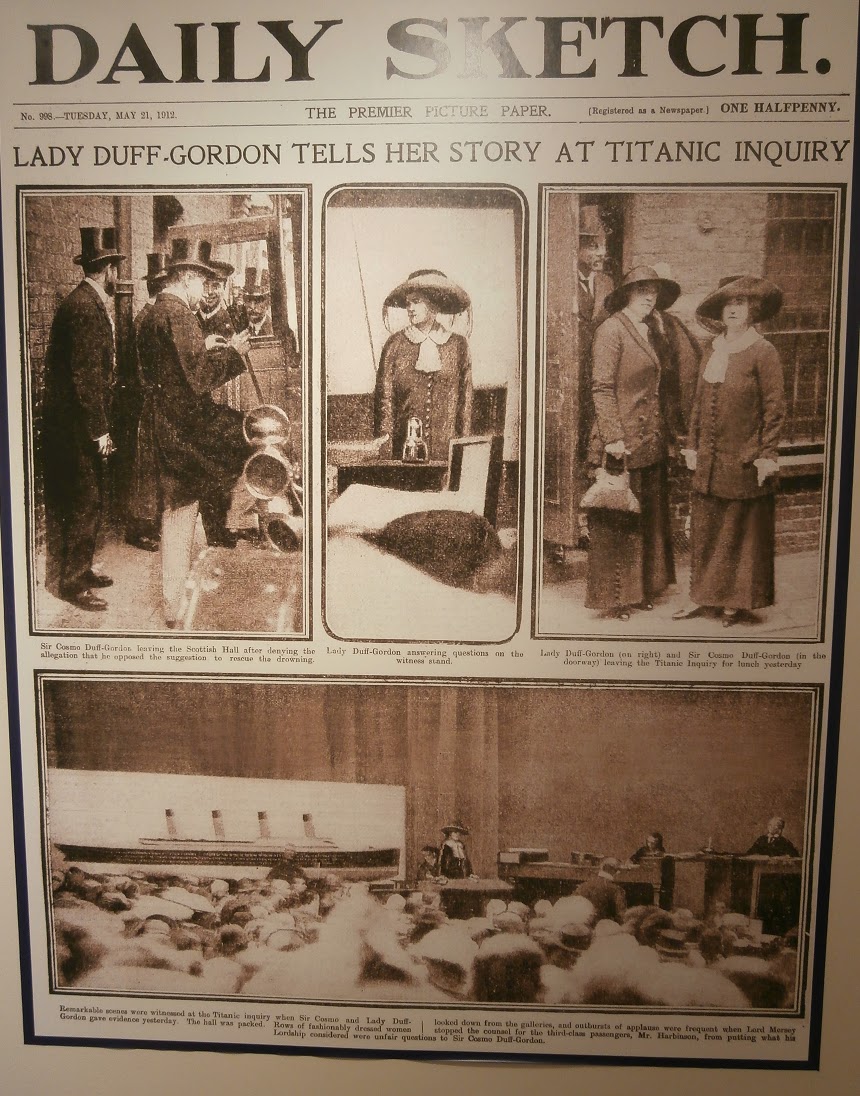
A general inquiry was held into the sinking of the Titanic and fueled by pressure from the tabloid press in both the United States and England a special inquiry was held into the circumstances surrounding the launch of Lifeboat 1.  The appearance of Lord and Lady Duff Gordon, the only passengers called to testify at any of the Titanic inquiries, resulted in the largest crowd of spectators.  Lord and Lady Duff Gordon were never formally charged in any wrong doing but the court did admonish that "occupants of Lifeboat 1 should have made a more concerted effort to rescue survivors from the water".
 
 Tidbit:

Lucile Duff Gordon really had no luck when it came to traveling by sea and it could even be said that she had somewhat of a charmed life when it came to boat and ship disasters ...

When her mother remarried she and her sister moved to the Isle of Jersey with their mother and her new husband, David Kennedy.  In 1875 following a visit to relatives in England, Lucy and her sister Elinor survived a shipwreck when their ship ran aground in a gale force storm.

Lucile escaped with her life when the Titanic hit an iceberg.

In 1915 Lucile had booked passage on the RMS Lusitania.  It was reported that due to illness she cancelled her trip at the last minute.  On that voyage, where Lady Duff Gordon should have been aboard,
the Lusitania was hit by a German torpedo and sank.

I guess three times is the charm. 


 SOME ITEMS OF PERSONAL INTEREST TO ME

A few years back I went to an exhibit of "Story Quilts" entitled "From Oma to Oma" which left me with a bit of a fascination of how people can make quilts to reflect a story as clearly as any written on a page.  There was one such quilt, crafted by fabric artist John Willard, hanging as part of this exhibit entitled "A Night to Remember".  It was a beautifully crafted piece of art and looking like the caps of waves were the names of all the passengers and crew members that sailed on the Titanic on that fateful voyage.  I was able to locate the names of Lucile and Cosmo Duff Gordon and Lucile's secretary, Laura Francatelli (admittedly with a little prompting from an arrow on the descriptive picture posted along side the quilt) as well as the name of another rather well known survivor, the "unsinkable" Molly Brown (which I found all on my own - thank you).


And since this after all a "book" blog I had to include the following which were displayed among the object in glass cabinets filled with the smaller sized mementos of Lucile's life and accomplishments.  Two first edition books concerning Lucile and her family.  Lucile herself wrote two autobiographies, the American first edition of the first autobiography was on display.


Lucile's sister, Elinor Glyn, was a rather well known author.  She was a journalist, screen writer and author who was quite notorious in her own life, causing scandal on both sides of the ocean.  It is widely accepted that Ms. Glyn was this first to coin the phrase "It Girl" in her novel "The Man and the Moment" which throughout the 1920's was a common term referring to "sex appeal".

Her book "Letters to Caroline" was also included and it features an original sketch by Lucille on the front flyleaf.


A rather sad sidebar to this exhibit is based on another "local connection".  Thomson Beattie was born in Fergus, Ontario which is 20 Km north of Guelph.  Thomson and two friends were traveling on a winter vacation when one of his friends became sick and had to return home.  Tired of traveling themselves Thomson and his other friend, lifelong companion Thomas McCaffry, decided to make their way home as well booking passage on the Titanic.  Thomas wrote his mother before leaving "we are changing ships and coming home in a new, unsinkable, boat".


Beattie and his companions did make it on to one of the last available lifeboats, a collapsible, but died of exposure waiting for rescue.  A month after the Titanic went down, from the deck of the liner Oceanic, a lifeboat was seen bobbing in the water.  The three bodies in the raft were sewn into canvas bags and buried at sea.  Thomson Beattie was still wearing the evening clothes he had worn on the Titanic that last night.


In a coincidence odd enough to give you goose flesh ... Thomson Beattie was buried at sea on his mother's birthday at almost the exact spot were where she had been born 82 years earlier ... in the Atlantic ocean on a ship bound for Canada.

He is remembered with a stone on the family grave site in Fergus, Ontario.


So very many things I learned today because of one name in a book!

Thanks for reading.


Thursday, 14 May 2015

Not All Stories are Written on a Page

I am very fortunate because I live in a medium sized city that has all the amenities I could hope for, is within an hour's drive of a large metropolis with arts and culture venues galore yet if I drive for 20 minutes north I find myself in farm country.  Said farm country has a very large Mennonite population, which mean farmers markets filled with farm to table foods, yummy preserves, free range eggs and homemade craft items including AMAZING QUILTS.

Once a year the region hosts the Mennonite Relief Sale, where the most gorgeous quilts are auctioned off in support of charities.  I noticed today that the featured quilt for 2015 is African themed and it has it's own story about how it came into being.  Not only that but imagine the stories told around the quilting frame as it was being stitched!

It also reminded me of an exhibition of quilts that I went to see last year that knocked my socks off.  Each one told a story that both amazed and humbled me.

Last Spring I was flipping through my community newspaper when the headline “From Oma to Oma” caught my attention.  The article was promoting a new exhibit at the Conestoga Mall Museum.  My first reaction was “Hmmm?  I didn’t know Conestoga Mall had a museum?”  As it turns out – they do!  It is one room of, to the best of my approximating skills maybe 800 square feet, tucked into an inconspicuous corner of the mall between the movie theatres and The Bay department store.   Now in all honesty, to call it a Museum is nothing short of an overstatement, however, calling it a Buried Treasure would be very true. 

But I am getting ahead of myself. 

The article explained that the museum was having a showing (and eventual sale) of quilts designed and sewn by Canadian grandmothers in support of their counterparts in Africa.  I learned about the plight of African grandmothers who have, by necessity, become very central to the life of their communities.  African grandmothers have stepped in to care for their grandchildren orphaned by AIDS, helping them through the loss of their parents, even as they are grieving themselves.  Often these grandmothers are widowed, with no form of income, yet they are taking on the raising their grandchildren.  The task of providing for their orphaned grandchildren is daunting.  The Grandmothers to Grandmothers Campaign (or Oma to Oma as the paper called it) helps raise funds to enable the African grandmothers to feed, clothe and house their grandchildren, as well as send them to school.

As one Canadian grandmother of Ethiopian descent stated, “I can see that women suffer a lot there – like in other parts of the world.  Grandmothers are the most forgotten part of the society.  There is no social security system that provides support for grandmothers.  When things are bad for everyone else, it is worse for them.  Support one grandmother, and you are making a difference in the lives of generations.  Together we can change the world, one woman – one grandmother – at a time.

Thus a group of local grandmothers decided to make quilts, the proceeds from which will go directly to the Campaign.

The exhibit of the quilts intrigued me enough to want to go and see them so I checked out the museum’s hours and found that they are only open Tuesday through Friday from 1 p.m. until 4 p.m. Well, that certainly was not going to work for me.  They are open on Sundays during the summer.  At the time I read the article July and August seemed very far away, so I filed the exhibit away in the back of my mind.


In May 2014 I read and reviewed (https://www.goodreads.com/review/show/925869640
a book by Sue Monk Kidd titled “The Invention of Wings”.  Charlotte, one of the central characters in the book was making a story quilt of her life.  Each square represented a milestone.  The description of the quilt and the quilting process was intriguing and it reminded me of my interest in visiting the quilt exhibit.


As craft-y as my mother was she did not do quilting.  I have a couple of crocheted blankets that she made, and many crocheted cotton doilies and tablecloths, which in my opinion are works of art.  I have seen pictures of doilies framed and used as wall art.  (Damn you Pinterest!) Those doilies were labors of love for my mom so someday I think I would like to take a few of my mother’s and do that … SOMEDAY!

Two years ago I was feeling a little maudlin about the upcoming Christmas season.  I wanted to make a gift for my girls that they could keep and remember me by when I wasn’t around anymore, the way I have my mom’s doilies.  Not having much of a talent in the arts and crafts department I couldn’t think of anything that was THAT lasting.  A quilt did come to mind, but I have neither the patience nor the stitching ability for a project like that.  I did come across something called a “Rag Tied Quilt” which involves no sewing what so ever.  That was right up my alley talent-wise.


I enthusiastically undertook the making of two of these “Rag Tied Quilts” and halfway through the process wondered what I had gotten myself into.  Just the measuring and cutting of the squares tested my meager reserves of patience – alas – I persevered.  What choice did I have?  What else was I going to do with hundreds of 10-inch by 10-inch squares of cloth?  I must admit that the faux-quilts did turn out rather well and the girls were very touched when they opened their gifts, especially since I had added a little personalized heart on one corner of the blanket.  My place in family history is assured now!

My youngest daughter has her quilt carefully draped over the corner of a loveseat in her apartment.  My eldest daughter lets the dog sleep on it!  And that, in a nutshell, is the difference between my girls! 

Let’s just say that another quilting project (like wallpapering the bathroom) is not anything I plan to undertake again any time soon.  I do think quilts are beautiful works of art and (after my experience) I totally respect the talent and time investment for the people involved in making them.  That being said, I can’t say that I am overly enthusiastic about quilting in general.

I would not describe myself as quilt-obsessed.  Yet, a thread had been pulled (not literally thank goodness – since we ARE talking about quilts) and I did want to go and see this quilt exhibit.  So on Sunday afternoon I took myself off in search of this mysterious, hitherto unheard of, museum.

I did find it, exactly where the website said it would be.  As I cautiously opened the door a very nice young lady approached me and asked if I had been to the museum before.  I responded that I had not and that, in fact, had not known that it existed until I read the article in the Community News.  She nodded her head and said that she “hears that a lot”.  She explained to me that there was no charge for entering the Museum (room!) and I was free to take my time, but please put on the disposable gloves they provided if I was tempted to touch the quilts.  Chuckling to myself, I told her those would not be necessary.  Let me tell you, I never did don the gloves, but there were a couple of moments where it was extremely tempting.  The quilts were astounding and I defy anyone not to describe them as “art”. 

I made a turn around the room to look at the quilts not bothering to read the cards describing them.  Each one was more intricate than the one before.  When I came to the last quilt about seven minutes later (I emphasize how small this “Museum” is) I finally read the card that was posted beside it.  It was then I realized that some of the quilters had been to Africa; living and working with their “Oma” counterparts and some invested their talent and time only because they felt moved to help.  I started my circuit all over again this time carefully reading each card beside its respective quilt.  When I got to the last quilt I meekly walked over to the desk to ask the girl whether pictures were allowed to which she quickly responded “OH YES!”  (I think she was a tad overly enthusiastic – no doubt at actually having someone in the place.)  I started my circuit again, taking pictures of the quilts with the stories that I found most touching.

A picture truly can tell 1000 words and each of these quilts told a story within its frame.  I was awestruck!  

Some of the pieces that particularly spoke to me are below.

By:  Nancy Winn, Waterloo, Ontario
Title:  Footprints for Change

“In the summer of 2011, I traveled to Africa (Uganda) on a mission trip.  I was overwhelmed by the great distances women traveled by foot.  They travel for their basic needs:  food, water, education and worship of God.  By simply putting one foot in front of the other, these women remind us that our daily journeys are something to be thankful for.”


By:  Mary Ann Gilhurst, Waterloo, Ontario
Title:  A Place to Grow

“The Stephen Lewis Foundation publication “Grassroots” (Summer 2009) had a story about a 96-year-old grandmother from Malawi, who was caring for four orphaned grandchildren in a hut with a mud floor and a leaky roof.  The Stephen Lewis Foundation sponsored Hope for the Elderly (HOFE) that repaired her roof and helped her with food.  She had a home that could be repaired but many sub-Saharan African women lose their homes when their husbands die.  If a grandmother has a home and an area to grow food, she can better care for, raise, even educate her grandchildren.  They can go from starving to thriving.”


By:  Dorothy Holdenmeyer
Title:  Women Do the Walking While Men Do the Talking

(Unfortunately I did not make not make note of this quilt’s description)


By: Lynne McCulloch, Burlington, Ontario
Title:  Helping Hope To Rise

“I wanted to represent that Canadian women have provided hope to grandmothers struggling to raise their grandchildren.  The base area contains friendship block in Canadian colours to suggest the support given.  The friendship provides a basis for hope.  The three female figures represent a grandmother, a child and a daughter whose generation is threatened by AIDS.  The dancing women dressed in colourful garments are celebrating their hope for a better future.  The butterflies rising and hovering at the top suggest hopefulness provided by the financial contributions and anti-viral drugs helping to save lives.”


By:  Margaret Hope, Oshawa, Ontario
Title:  Faith, Hope and Charity

“I am truly blessed with good eye sight, hands that work well and a vivid imagination.  My birthday is in May and I will be 91 years old.  If in some small way this art pieces helps the African grandmothers, it will be my way of counting my blessings.”


By:  Elaine Graham, Kitchener, Ontario
Title:  Floating Dandelions

“Dandelions embody many of the same qualities that African and Canadian grandmothers possess.  All are beautiful, playful and deeply committed to grow wherever they land.  Grandmothers, like dandelions, are hardy and strong with deep roots.  Both are bright, playful, and at times a little bit out of control.  Sadly, there are times when both are dismissed or ignored.  In Canada, as dandelions begin to emerge from the winter’s ground, we find hope that spring is on its way and that the long winter is behind us for another year.  Hope, renewal and new life are present in Grandmothers and dandelions.  I hope that this piece of art reflects and celebrates these ideas.”


By:  Judy Pearce, Kitchener, Ontario
Title:  Nyanya

“I am called Nana.  She is called Nyanya (Nyanya means grandmother in Swahili).  When my grandchildren are in my care, my children come home after a few hours.  Her children do not return.  I hope, in some small way, this piece will help her find the resources she needs to cope with her huge responsibility.”


By:  Mary Walsh, Waterloo, Ontaro
Title:  Rooted in Spirit

“Inspired by my great admiration for Africa’s grandmothers, Rooted in Spirit expresses my vision of a grandmother as an Acacia tree, a maternal symbol of protection, provider and link to the past.  Often standing alone, she is tall, strong, resilient and full of grace.  She is firmly rooted in the present as she raises her arms (tree limbs) to embrace her grandchildren while deeply connected to the sleeping souls (in the roots below) of her adult children lost to the AIDS pandemic.  She is caring, full of hope for the future and deeply rooted in spirit.”


I’m glad I went to see these cloth and thread masterpieces that each tell their own story.  It amounted to a grand total of about one-half hour out of my Sunday afternoon that I consider very well spent.